
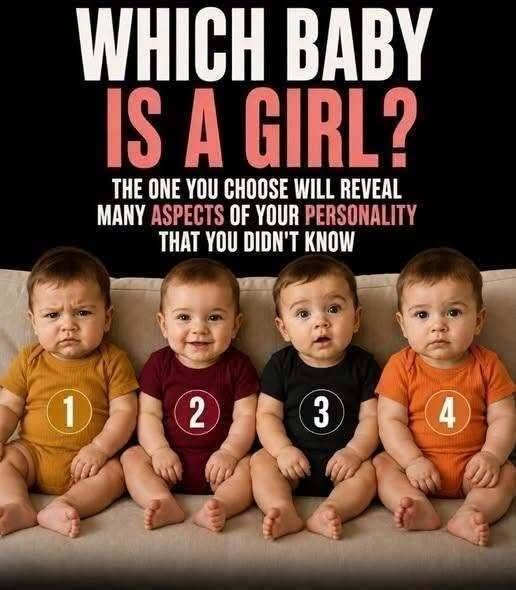
Psychological Test: Which of These Four Babies Is a Little Girl?
A viral personality challenge claims your choice reveals hidden traits—but the real answer may surprise you.
Social media is full of quizzes that promise to reveal something meaningful about our personalities in just a few seconds. One of the latest viral challenges asks a seemingly simple question: Which of the four babies in the picture is a little girl?
At first glance, the task appears straightforward. Four babies sit side by side, each displaying a different facial expression and demeanor. Participants are encouraged to rely on their instincts and select the baby they believe is a girl. But as many quickly discover, the answer is far from obvious.
Why Has This Test Gone Viral?
The challenge has attracted millions of views because it combines curiosity with self-discovery. Rather than focusing on facts or logic, it encourages people to trust their first impression.
Many participants become intrigued not because they expect to identify the baby’s gender correctly, but because of the personality descriptions associated with each choice. The idea that a quick decision could reveal hidden character traits makes the challenge both entertaining and highly shareable.
As a result, friends and family often compare answers and debate what their selections say about them.
The “Popular Answer”
According to the explanation commonly shared alongside the image, Baby Number 2 is considered the “correct” choice.
Those who choose Baby Number 2 are often described as:
Warm and compassionate
Emotionally intelligent
Friendly and approachable
Naturally optimistic
Drawn toward meaningful relationships
Supporters of the test claim that people who select this baby tend to value kindness, emotional connection, and positive energy.
What Does Science Say?
Despite the popularity of the challenge, experts point out an important fact: there is no reliable way to determine a baby’s gender simply by looking at a photograph.
At a very young age, babies often share similar facial features and physical characteristics regardless of gender. Expressions, clothing colors, and hairstyles can influence perception, but they do not provide scientific evidence.
In reality, the challenge is less about identifying a girl and more about understanding how people make judgments under uncertainty.
O resto si pe aver rig
